

The EU Deforestation Regulation (EUDR) is approaching
The EU Deforestation Regulation (EUDR) applies broadly across supply chains and sectors. The EU Parliament and Council have decided to postpone the entry into force of the EU Deforestation Regulation by one year. For large and medium-sized companies, the regulation will apply from 30 December 2026. For small companies, the transition period will continue until the end of June 2027.
The regulation covers seven commodity groups (wood, cattle, coffee, cocoa, soya, oil palm and rubber) as well as several products made from them (listed in Annex 1). These commodities and products can only be placed on the market when they have not caused deforestation, when they have been produced in accordance with the legislation of the country of production and they are covered by a Due Diligence-statement or a simplified declaration if a micro and small primary operator.
- Use this role-based checklist to understand who is in scope and how to prepare.
- Learn how the essentials translate into everyday situations and concrete next steps.
Quick self-check on EUDR
Am I in scope?
- Do you place on the market or make available domestically or in the EU, or export from the EU, EUDR-covered commodities/ products?
- Are you acting mainly as an operator (placing on the market for the first time or exporting) or a trader (making available, i.e. any distribution, consumption or use of the relevant products)?
- What is your company size (micro/ small vs. medium/ large)?
Note:
- If you are a large undertaking engaged in trade, you are treated as an operator under the EUDR – follow the Operator checklist.
- Some obligations are size-dependent (e.g., simplified declarations for micro and small primary operators and annual public reporting for large operator undertakings).
Pick your role below to see what to do next.

Operator: what to do
✅ Establish a due-diligence (DD) system by:
- collecting information, data and documents needed to demonstrate that your products do not cause deforestation compliance
- carrying out a risk assessment on the basis of the collected information above to establish whether there is a risk that the relevant products might cause deforestation
- unless the risk assessment reveals that there is no or only a negligible risk, adopt risk mitigation procedures and measures. This system underpins your DD-statement.
✅ File your DD-statement in TRACES and share the reference
Complete the DD-statement or if a micro and small primary operator a simplified declaration in TRACES before imports/ exports/ placing on the market, then pass the statement’s reference number to corporate customers for the relevant batch.
Note: SME operator engaged in further processing
If you are a natural person, micro-, small- or medium-sized operator engaged in further processing, you do not need to prepare a new DD-statement. Obtain the upstream DD-statement reference number, pass it on to your (corporate) buyer, and keep the records.
✅ Keep monitoring and reviewing
Track regulatory updates and national guidance; periodically review your DD system. Large operator undertakings must publish an annual report on their DD system.
Trader: what to do
Note: Are you a large undertaking engaged in trade?
If you are a large undertaking engaged in trade, EUDR regards you as an operator. Follow the Operator checklist.
✅ Clarify your obligations and size
Confirm whether you are micro/ small or medium enterprise.
✅ Keep and pass DD-statement reference numbers
Obtain and retain the DD-statement reference number for relevant products; pass it forward to corporate customers when required.
Note: SME traders
Natural persons and micro-, small- or medium-sized enterprises engaged in trade (SME traders) do not prepare their own DD-statements. Your duty is to collect, keep and pass DD-statement reference numbers and maintain the required records.
✅ Maintain traceability and records
Maintain supplier and product records and be ready to respond to authority requests.
✅ Stay updated
Monitor regulatory updates and adjust processes as guidance evolves.
Five real-world scenarios
1. Construction company using tropical timber for formwork and interiors, imported from outside of the EU
Usually an operator, since it places wooden materials on the EU market through procurement and use. Must establish a DD-system and ensure that the suppliers of the imported wood products comply with EUDR requirements.
Do this now: establish whether you are an operator or a micro and small primary operator.
For operators: review your timber suppliers and establish a DD-system, file the statement in TRACES and share the reference, if required.
For micro or small primary operators: review your timber suppliers, establish a DD-System and submit a one-time simplified declaration in the information system before placing relevant products on the market or exporting them and share the declaration identifier, if required.
2. Large construction materials wholesaler importing plywood and laminated beams
A large undertaking engaged in trade, which under EUDR is treated as an operator. Needs its own due-diligence system and needs to submit DD-statements or simplified declarations if it is a micro and small primary operator for every import batch in TRACES.
Do this now: identify EUDR-covered products in your catalogue, assign internal owners for TRACES submissions, and create a process to pass reference numbers to downstream customers.
3. Food distribution company importing cocoa and palm-oil products
Typically an operator, because it introduces imported foodstuffs to the EU market. Must have a due-diligence system and file DD-statements or simplified declarations in TRACES.
Do this now: establish whether you are an operator or a micro and small primary operator. Map your imported product lines, collect supplier information, and test one pilot DD-statement or a simplified declaration to understand data requirements and timelines.
4. SME food wholesaler sourcing packaged chocolate and coffee from EU suppliers
Usually a trader. Does not prepare its own DD-statements but must keep and pass the upstream reference numbers received from suppliers.
Do this now: contact your key suppliers to obtain DD-statement references or the declaration identifiers; log them in one shared register and ensure they follow the products to your customers.
5. Automotive manufacturer using natural rubber components in tyres and seals
Generally an operator, because it places products containing natural rubber on the EU market. Needs to establish a DD-System for the rubber in its supply chain and ensure that the risks of deforestation are mitigated.
Do this now: establish a DD-System by first identifying suppliers of rubber parts, collect the relevant information, carry out a risk assessment and file the DD-statement or a simplified declaration if a micro and small primary operator in TRACES.
Key dates and scope reminders
- Main applicability date: 30 December 2026.
- Extended transition for micro- and small-sized enterprises: until the end of June 2027 (note: the extension does not apply to products still covered by EUTR, the EU Timber Regulation).
- The EUDR scope includes wood, cattle, coffee, cocoa, soya, oil palm, rubber, and products made from them that are listed in Annex 1 to the EUDR.
Why prepare now?
From customs clearance to reputational risk, companies that have the DD-statement ready, understand their role, and can evidence their process avoid delays and surprises once the EUDR applies. Early preparation improves supply-chain transparency and reduces the risk of non-compliance and last-minute scrambles.

Make EUDR Manageable with EHS Compass
EHS Compass turns EUDR obligations and other evolving EHS compliance duties into a manageable, auditable workflow. EHS Compass by Ramboll® brings your requirement registers, monitoring, assessments, and action follow-up into one place so your team can act on what matters.
- Regulatory Monitoring: Track EU and national updates; push relevant changes straight to your Legal Register and action plan.
- Legal Register: Centralise EUDR obligations with acknowledgements and review dates – your audit trail in one place.
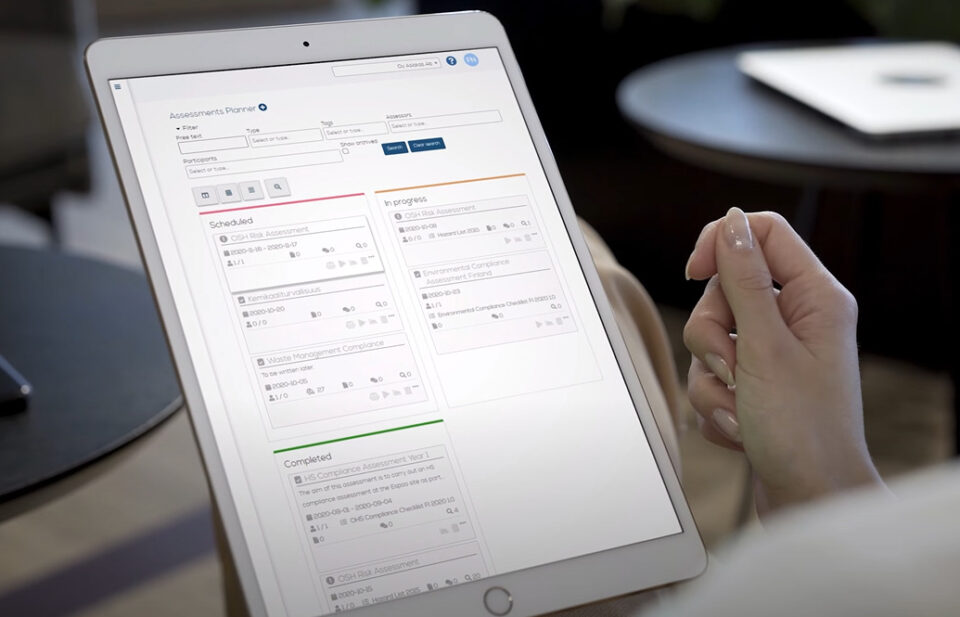
- Assessments: Run DD-system and supplier-risk checks with repeatable templates; compare results over time.
- Actions & Reminders: Assign owners, due dates and follow-ups to close gaps fast.
- Dashboards & Reports: Show readiness and progress across one or many sites, and export clean reports for management.
Nina Cross
Product Owner - EHS Compass
How can we help?